Veronika is my quilter.

She went with me this week to Davidene's to each a class in hand quilting. I sat her in her little chair and asked the students to tell me what she needed. We got: pillow, footstool, water bottle, quilt, hoop, needle, thread, thimble (that fits—not easy for her tiny fingers), scissors and some entertainment, like music or a good audiobook. I used her quilt to show how to handle quilting over and along seams, but otherwise, my life-size demo was done with the whole cloth quilt I'm working on, because it was easier for students to see on a solid, light-colored background.
We thought the class went well, and the students said they were very excited about doing some hand-quilting now. My handout is here.
Davidene had this quilt to show.

The fabric manufacturer had a pattern to use with these fabrics, but Davidene and her staff designed their own, using some ideas they liked from the pattern.
Another student showed us this appliqué project. It's all wool, except for some of the leaves and the embroidery.

There's an ant to the right of the vase, but it doesn't show up very well in the photo. Very cute!
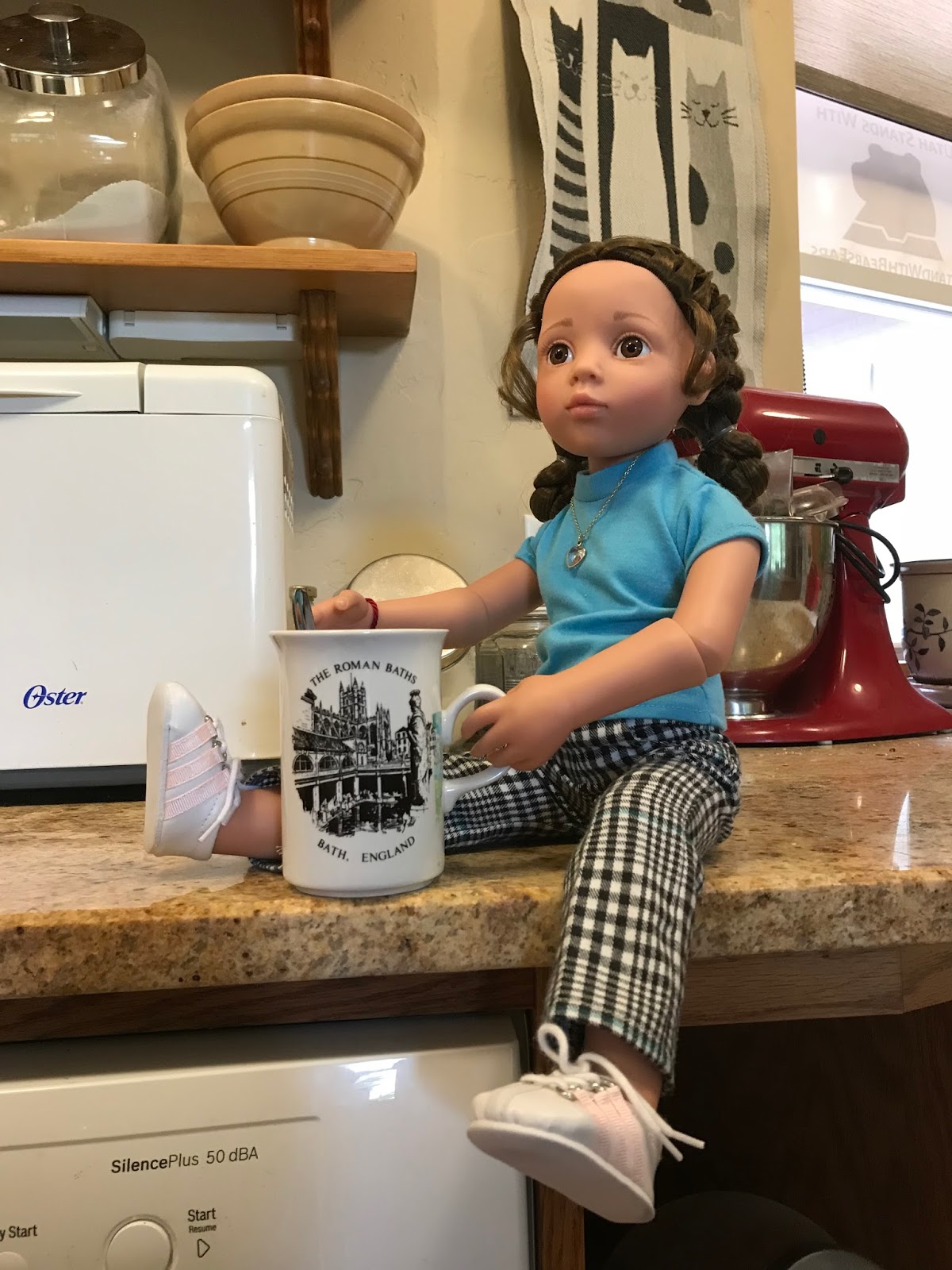
It was past Veronika's bedtime when we got home. She slept late, but she needed a very big mug of coffee when she got up.
Thursday morning I went to Common Threads at Karan's. She had placed her appliqué quilt on the wall over the fireplace.

Karan has been working on come cutwork and had this to show.

She had finished working on this wool flannel appliqué...

...and these snack bags.

Kathleen was knitting, but she had brought this beaded hummingbird to restring. It's supposed to hang from fishing line from the ceiling at a window, and the line had broken.

In the meantime, I had finished the Russian dress I was trying to reverse-engineer a pattern for (make up a pattern by looking at the finished project).

The resulting pattern is here.

I wanted it a little snugger at the waist, so I'm working on improvements while knitting another one.

In the meantime, I left Lotte sitting on the windowsill by the back door too long, and she discovered how to make the garage door go up and down.

We gave our piano to a family with several children who are learning to play. They picked it up on Saturday.

The new rail went in on Friday. It's a big drop down the stairs from that spot. All that kept the grandkids from diving off before was the piano.

What's on my needles: Still the Coastal Skies, a little more progress made, and the second Russian Dress.
What's on my Featherweight: More miscellaneous things to sort through.
What's in my hoop: Still the Spring Flowers quilt, but a lot of progress made this week.
What's on my wheel: Stanzi is in hibernation.
What's on my iPad/iPhone: Now listening to A Higher Loyalty by James Comey. Interesting so far.
What's in my wine glass: Charles Shaw (Two-buck Chuck) Merlot. Good value.
What's my tip of the week: When you knit a cardigan with built-in button/buttonhole bands, make the buttonholes at both ends. This is easy enough to do, and the ones you don’t need to use can be used for button placement. The added advantage is, if anyone ever wants to change the buttons to the other side (to hand the cardigan down to a younger sibling of the opposite sex, for instance), the buttonholes are there. Or if you’re making a baby cardigan and you don’t know the baby’s gender yet.
Note: This blog post was produced on the iPad and the MacBook, using the iPhone for some photos and some photo processing. No other computer was used in any stage of composition or posting, and no Windows were opened, waited for, cleaned or broken. No animals or dolls were harmed during the production of this blog post.
—


